
Evidence-Linked Timelines for Defense Litigation without Spreadsheet Pain
If you manage litigated claims or oversee a portfolio of defense matters, you’ve probably seen this pattern play out…
If you manage litigated claims or oversee a portfolio of defense matters, you’ve probably seen this pattern play out: everyone agrees the “timeline” is critical, but the thing called a timeline is often a fragile Excel spreadsheet (or a Word table) that’s outdated the moment someone opens it.
The problem? The work keeps moving: new productions, supplemental disclosures, amended pleadings, additional depositions, new expert analyses, even shifting liability theories. The timeline becomes either a one-off artifact created when defense counsel thinks it will be useful, or a “living” document no one trusts because it’s too hard to maintain.
That problem is magnified in enterprise settings. Corporate in-house teams and insurance organizations are managing portfolios, multiple jurisdictions, and panel firms. The timeline cannot be a static artifact that gets refreshed only when trial is looming. It needs to be dependable in the moments that drive decisions: reserve discussions, early case assessment, settlement posture, and ongoing case updates.
There’s a better way to think about timelines, especially for enterprise in-house and insurance teams trying to drive consistency across panel firms.
A useful timeline isn’t just a sequence of events. It’s a sequence of events linked to the evidence, reviewable, and always current. That way it can feed the work product that matters: claim reviews, case updates, mediation statements, deposition preparation, expert materials, motions, and trial outlines.
This post lays out a practical approach to evidence-linked timelines and how modern tools (including esumry.com) remove the “timeline maintenance job” by automatically extracting events from case materials, linking them back to sources, and keeping the timeline updated as the record grows.
What “evidence-linked” means in practice
A timeline becomes useful when it answers two questions at the same time: what happened, and how do we know?
Most timelines only do the first part. They summarize a story. If someone challenges an entry, the team has to hunt through emails, PDFs, transcript excerpts, claim notes, or a file share to find support. That creates friction and slows decision-making. It also introduces risk, because memory and interpretation start to fill the gaps where the record is unclear.
An evidence-linked timeline treats each entry as a verifiable fact unit. Each event is anchored to its source material, so the proof is always one click away. Instead of a narrative you must trust, you have a timeline you can verify.
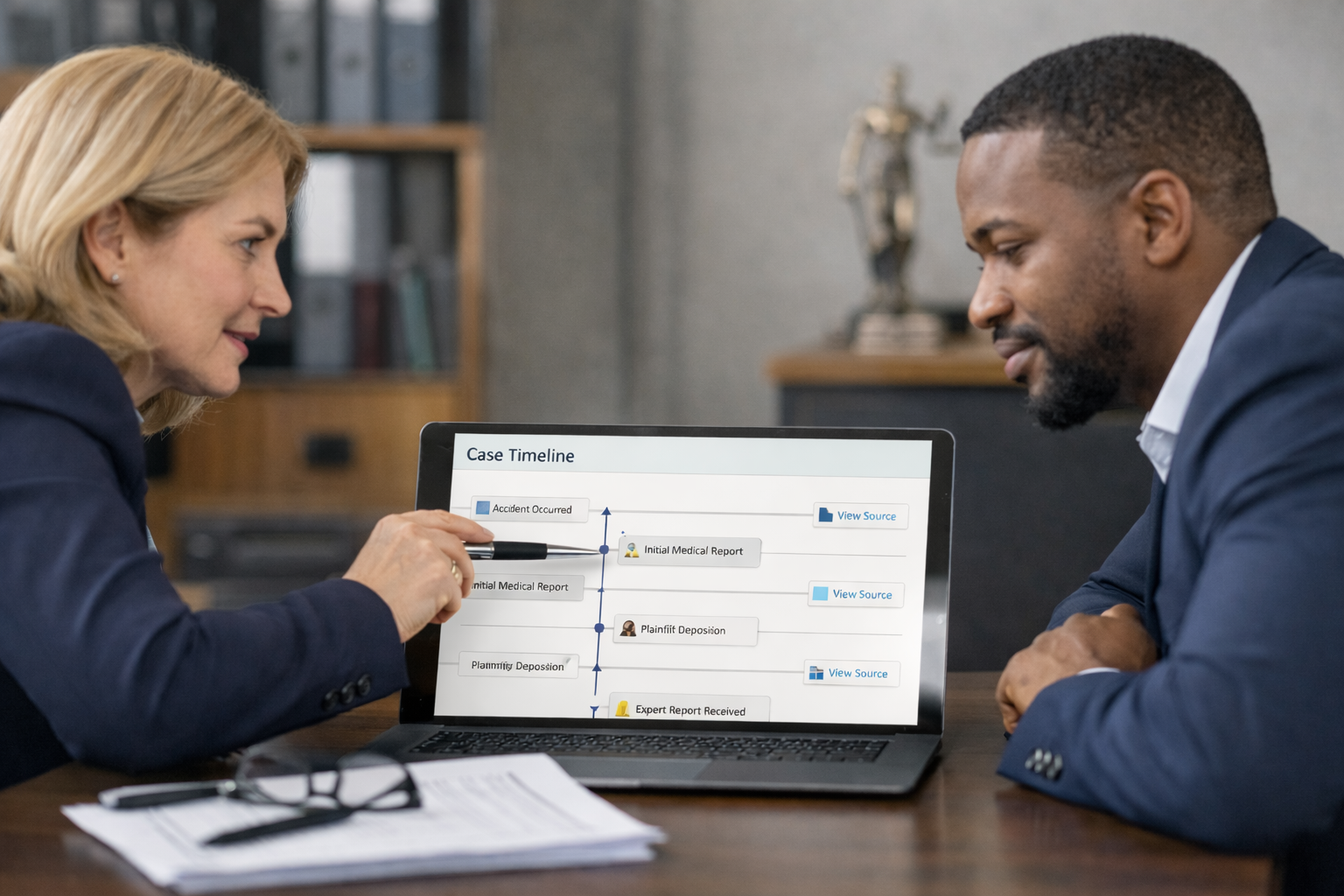
With esumry, the timeline is generated automatically by extracting dates and events from case documents and testimony materials. As new documents or testimony are added, the timeline updates automatically. Every timeline event is linked to the source material that supports it. That means the timeline is not “maintained” manually. It stays current because it is built from the record itself.
The timeline is displayed visually so users can scan the chronology quickly and toggle source materials on or off to move between a clean overview and a proof-forward view. Events can be edited in the app, which matters because judgment still matters. Automation accelerates the work, but humans still refine phrasing, add nuance, and align the timeline to the evolving theory of the case.
Finally, because litigation and claims work often requires portable deliverables, the timeline can be exported to Excel or Word for use in standalone presentation software and other internal workflows.
The real pain is keeping the timeline up-to-date as the record changes
Every case evolves. That sounds obvious, but most timeline workflows are built as if the case will sit still. A manual timeline might be accurate for a week, then falls behind as people get busy. When a reserve discussion comes up or a mediation statement needs to be drafted, the team scrambles to reconcile the timeline with what has changed.
This is not a small inefficiency. It affects outcomes. A stale timeline drives the wrong focus, the wrong valuation conversations, and the wrong strategy choices. When leadership reviews a case, they are not just reading facts. They are deciding what matters. If the chronology is out of date, that judgment is working off a distorted picture.
An automatically updating timeline changes the rhythm of the matter. Instead of periodic timeline rebuilds, the record becomes the timeline. When new material arrives, the timeline updates. When counsel or a claims leader wants to verify a critical point, the source link is already there. When the team needs a snapshot for a meeting, mediation, or trial prep, they can export what they need without rebuilding the chronology from scratch.
Why this matters to in-house, claims, and defense counsel at the same time
Evidence-linked timelines are one of the few work products that reduce friction across stakeholders rather than shifting it from one group to another.
For corporate in-house and insurance claims teams, the value is speed and confidence in review. When the timeline is verifiable, leadership can move quickly through the record, focus on the decision points, and spot gaps that need follow-up. Portfolio oversight improves because the same detail and structure can carry across matters and panel firms.
For defense counsel, the value is reduced rework and better drafting inputs. A huge portion of litigation time is spent organizing and reorganizing facts for different deliverables. A fact chronology for a case update becomes a fact chronology for a deposition. That becomes a fact chronology for a motion. When each fact is already linked to the record, the process shifts from searching to assembling.
For experts and consulting witnesses, the value is foundation. A clean chronology tied to verifiable sources reduces confusion about what materials support which assertions and helps clarify reliance boundaries. It can also sharpen the focus of deposition preparation and rebuttal strategy.
The key is that the timeline is not just “shared.” It is shared in a way that preserves roles. Claims and in-house teams gain clarity and oversight. Defense counsel retains judgment and strategy. The timeline becomes common ground.
What a timeline must do to be truly usable
A timeline that works in real litigation has three qualities.
First, it is evidence-linked. Every entry points to a unique verifiable source document or testimony reference, so the proof is always available and reviewable. In esumry’s approach, entries are generated from unique sources. You are not merging duplicates or debating whether two notes describe the same thing. Each entry is grounded in a specific source.
Second, it is current. A timeline that is accurate but stale still creates risk. The record moves. The chronology needs to move with it. Automatic updates solve the maintenance problem and help ensure that leadership review and strategic discussions are based on the latest information.
Third, it is reusable. The timeline should not live as a dead-end artifact. It should feed claim reviews, case updates, mediation narratives, motion fact sections, deposition preparation, and trial prep. If the only way to reuse it is to copy and paste into yet another spreadsheet, you have not solved the core issue.
A visual timeline in-app supports reuse because it allows multiple ways to interact with the chronology. A claims leader may want a high-level scan. A trial team may want a proof-heavy view. A case manager may want to export a subset for a meeting. The same underlying timeline can serve all these needs when the system is designed around verification and portability.
An example: how an evidence-linked, auto-updating timeline supports mediation
Consider a serious bodily injury claim headed to mediation. The question the team must answer is not “what happened” in the abstract. The questions are more concrete: what facts drive liability, what facts drive damages, what facts introduce uncertainty, and what facts are likely to move the mediator and opposing counsel.
In a traditional workflow, the defense team builds a mediation chronology late, often under time pressure. They summarize key events and then scramble to attach support. Even if they finish, the chronology is a snapshot. If a supplemental production arrives or a late deposition transcript becomes available, the chronology can diverge from the record at exactly the wrong time.
With an evidence-linked, auto-updated timeline, the mediation workflow changes. As case materials are added, the timeline is already capturing the dated events that matter. When the team prepares for mediation, they are not starting from scratch. They are curating and shaping what already exists.
Here is what that looks like in practice:
Early in the case, the timeline captures the incident date, notice and reporting dates, and the first medical treatment dates. Those entries are linked to the underlying records, so a reviewer can verify details without leaving the timeline.
As discovery progresses, the timeline adds dated events from written discovery responses, document productions, and depositions.
When an expert report arrives, the timeline updates again, capturing dated liability or damages anchors.
By the time mediation is scheduled, the timeline serves as a structured index of what matters. The team can view the timeline visually to see gaps, toggle source material to verify any contested point, and then select the set of events that will form the mediation narrative.
The final step is simple: the curated timeline entries can be exported to Word for a mediation statement chronology or to Excel for sorting by date, source or topic in an internal mediation deck.
Editing matters: the timeline as a tool for professionals, not a replacement for them
Automation changes how fast a timeline can be created and updated. It does not remove the need for judgment.
Teams still need to refine language for clarity. They still need to flag disputed facts and decide how to frame them in briefing. They still need to decide what belongs in a claim review versus what belongs in trial prep. A good system supports those decisions rather than forcing teams into rigid templates.
With esumry, events can be edited directly in the app. That supports a balanced workflow: use automation to extract and structure the dated record, then apply human expertise to refine, prioritize, and present.
This also helps enterprise teams drive consistency without micromanagement. Instead of policing how each panel firm writes a timeline, the organization can standardize on a verifiable, record-based timeline and let counsel apply judgment to the presentation layer.
Timelines earn trust when they stay tied to proof and stay current
In claims and litigation, speed is valuable, but trust is essential. A fast timeline that is not verifiable will not hold up in internal review, mediation pressure, or trial preparation. A verifiable timeline that is stale will still lead teams astray.
Evidence-linked, automatically updating timelines solve both problems. They keep the chronology tied to proof and aligned to the live record. They reduce rework across in-house, claims, and defense counsel. They make it easier to prepare the deliverables that drive outcomes, from claim reviews to mediation narratives to trial prep.
When the timeline becomes dependable, it stops being a last-minute artifact and becomes a working asset. That is when timelines start doing what they were always supposed to do: help the team see the case clearly, make better decisions faster, and present the story with confidence.

Using esumry, privilege is protected with ZDR (zero data retention), and case analysis is fast, strategic, and secure. Create timelines, tag testimony, assess credibility, and get ahead of how the other side will use the record—before they do.
